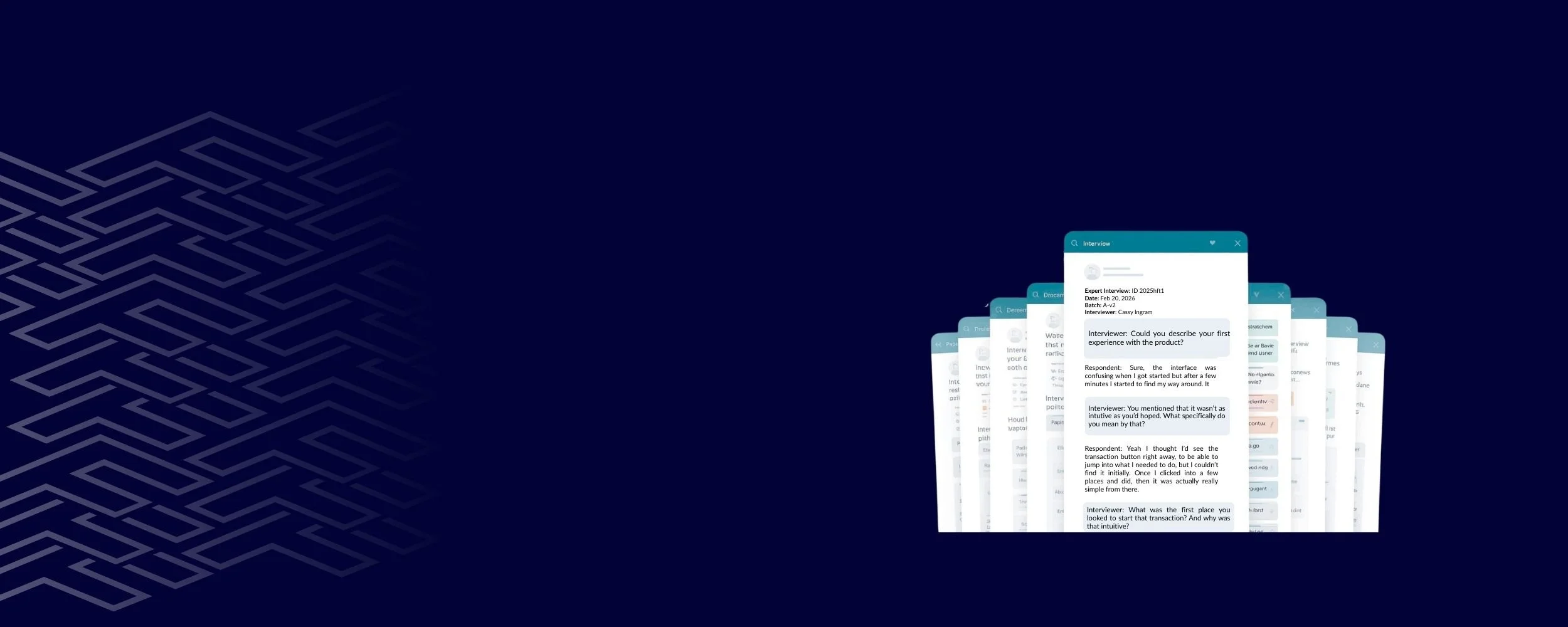
FEATURE RELEASE
IDI & Interview Analysis
Code & analyze interview transcripts at scale with Fathom
IDI & Interview Analysis: Research-Grade Coding at Scale
Researchers trust Fathom to analyze open-ended survey responses with the kind of accuracy, nuance, and speed that traditional methods simply can't match. Now that same research-grade text analytics powers interview transcript analysis.
If you've ever stared down a folder of IDI transcripts knowing the insights are in there, but dreading the weeks of manual coding ahead, this is for you.
Fathom now supports full analysis of interview and IDI transcripts: upload transcripts from any source, apply or generate a thematic code frame, and move from raw conversations to structured, quantifiable insights in a fraction of the time. Same research-grade quality. Now for the full spectrum of open-ended data, including qualitative interview analysis at scale.
Why Interview Transcript Analysis Has Always Been Hard to Scale
Interview research is irreplaceable. The depth, context, and nuance you get from a real conversation, whether it's a 60-minute IDI or a series of user interviews, simply doesn't exist in a checkbox survey. Researchers know this. That's exactly why interviews remain central to qualitative and mixed-methods research.
The problem isn't the interviews. It's what happens after.
Manual transcript analysis is slow, inconsistent, and difficult to scale. A single interview can take 30–60 minutes to code thoroughly. A study with 50 interviews becomes weeks of work. And the bigger the dataset, the harder it is to maintain consistency across coders, let alone confidence that nothing meaningful slipped through.
General-purpose AI tools like ChatGPT can produce a rough summary. But a high-level summary isn't analysis. It won't give you a defensible code frame, accurate theme coverage across hundreds of transcripts, or the transparency and auditability that professional research requires. When insights inform real decisions about product strategy, brand positioning, or policy, the quality of the analysis genuinely matters.
Fathom is built for exactly this: high-quality, scalable, transparent analysis of open-ended data. And now that includes interviews.
Accuracy and Control, Without the Manual Work
What separates Fathom from general AI tools isn't just speed. It's the combination of accuracy, transparency, and researcher control that makes the output actually usable in professional research.
Fathom's AI detects themes, applies codes, and structures your data with a level of nuance and consistency that generic tools can't match. The results are fully transparent and auditable: you can see exactly how transcripts were coded, drill into individual passages, and refine anything that doesn't land right.
For many studies, especially large interview datasets, the workflow is straightforward: upload, review the generated code frame, accept, and move to analysis. For studies requiring tighter methodological control, Fathom gives you the tools to apply a custom code frame, adjust at the theme or passage level, and iterate as your thinking evolves.
Either way, you stay in control. The AI handles the scale. You own the analysis.
Interviews are rich and messy by nature. They meander, surface unexpected themes, and require judgment calls that simple pattern-matching gets wrong. Fathom is designed to handle that complexity without sacrificing accuracy or depth.
What You Can Do With Interview Transcripts in Fathom
Upload Transcripts From Any Source
Fathom accepts transcripts from a wide range of research and conversational formats:
In-depth interview (IDI) transcripts
UX and product research interviews
Customer and user interviews
AI-moderated research interviews
Customer service and chat transcripts
Conversational feedback datasets
Whether transcripts were generated from in-person sessions, phone calls, video interviews, or AI-moderated platforms, Fathom automatically cleans, formats, and prepares the data for analysis. No manual prep work. No reformatting.
Apply Your Code Frame — Or Let Fathom Build One
Once transcripts are uploaded, you have full control over how they're coded.
You can automatically generate a thematic code frame based on patterns Fathom detects across the dataset, apply an existing code frame you've already developed, or start with generated themes and refine them as your analysis evolves. Code frames can be customized to align precisely with your research objectives, so the analysis reflects your study's unique context, not a generic interpretation.
This flexibility matters. Different studies call for different approaches, and Fathom is designed to support how researchers actually work, not force them into a rigid process.
Quantify, Compare, and Interrogate
Coded transcripts unlock a layer of analysis that manual approaches rarely make practical:
Quantify themes across the full dataset to understand what appears most frequently
Segment and compare patterns across participant groups, demographics, or other variables
Identify emerging issues and unexpected themes that might not be visible at smaller scale
Generate summaries and key takeaways grounded in rigorously coded data, not AI guesswork
The ability to move fluidly between the richness of individual transcripts and the patterns across a full dataset is where Fathom genuinely changes what's possible in interview research.
Ask Questions of Your Data With Fathomer
Once your transcripts are coded, Fathomer, Fathom's agentic research assistant, lets you interrogate the dataset in natural language.
Ask things like:
What themes appear most often across these interviews?
How do product complaints differ between user segments?
What patterns show up across both this interview study and our last survey?
That last question points to one of Fathom's most powerful capabilities. Fathomer can work across multiple datasets simultaneously, combining interview transcripts with survey open-ends, customer feedback, or other sources to surface connections that would be nearly impossible to find manually. For researchers running multi-modal studies or longitudinal research programs, this opens up a new level of analysis.
Fathomer works from your coded, structured data. The answers it generates are traceable and grounded in your analysis, not a model's best guess.
One Platform for All Your Open-Ended Data
Fathom was built around a simple but powerful idea: open-ended data, whether from surveys, interviews, or other conversational sources, deserves the same rigor and analytical depth as structured data. It shouldn't require weeks of manual work, inconsistent coding, or compromises on quality.
With interview transcript analysis now part of the platform, Fathom supports the full range of open-ended research data in a single place:
Open-ended survey responses
Interview and IDI transcripts
UX and user research conversations
Customer feedback datasets
Service and conversational transcripts
Research teams can run complete studies, surveys and interviews analyzed with the same methodology and comparable outputs, without juggling multiple tools or stitching together results from different platforms.
What Fathom Makes Possible for Qual at Scale analysis
Over 95% reduction in analysis time — studies that took weeks now take hours
Research-grade accuracy and nuance from AI purpose-built for professional text analysis
Full transparency and auditability so findings are defensible at every level
Customizable code frames that align with your research objectives, not generic themes
Scalable without compromise — analyze dozens or hundreds of interviews while maintaining the depth that makes interview research valuable
FAQ: Interview Transcript Analysis
How do you analyze multiple interview transcripts?
Analyzing multiple interview transcripts requires applying a consistent coding framework across all conversations so themes can be compared and quantified across the full dataset. Researchers typically upload transcripts, develop or apply a code frame, and use text analytics software to structure and explore patterns at scale. Platforms like Fathom automate this process, reducing analysis time by over 95%.
How do you code qualitative interviews?
Qualitative interview coding means labeling segments of a transcript with thematic tags that represent key ideas, topics, or sentiments. Codes can be generated inductively from the data or applied from a predefined framework. Once coded, themes can be quantified and compared across participants or studies. Fathom supports both approaches, with options to auto-generate, apply, or refine code frames.
How long does it take to analyze interview transcripts?
Manual coding of a single interview typically takes 30–60 minutes depending on length and complexity. For studies with dozens of interviews, full analysis can take days or weeks. AI-powered text analytics tools can reduce this significantly — Fathom cuts analysis time by over 95%.
Can AI analyze interview transcripts accurately?
AI can identify themes and patterns across interview transcripts, but accuracy varies significantly by tool. General-purpose models like ChatGPT produce summaries rather than structured, auditable analysis. Purpose-built research platforms deliver more consistent coding, better nuance, and the transparency that professional research requires.
What is the best software for analyzing qualitative interview data?
The best qualitative interview analysis software combines accurate theme detection, flexible code frames, and the ability to scale across large transcript datasets without losing nuance. Key features to look for include custom coding, segmentation, cross-dataset analysis, and full auditability. Fathom is built specifically for professional market research and insights teams working with open-ended data at scale.
Can interview transcripts be analyzed alongside survey responses?
Yes. Combining interview transcripts with survey open-ends allows researchers to identify patterns across both data sources and build a more complete picture of their research questions. Text analytics platforms that support multiple data types make this analysis more consistent and efficient. Fathom supports both in a single platform, with tools to explore patterns across combined datasets.
What types of interview transcripts can be analyzed with text analytics tools?
Text analytics tools can analyze a wide range of interview transcript types, including in-depth interviews (IDIs), UX and product research interviews, customer interviews, AI-moderated sessions, and customer service conversations. Most platforms accept transcripts from any source, whether generated from in-person sessions, phone calls, or video platforms.
How many interview transcripts can be analyzed at once?
Modern text analytics platforms are built to handle datasets ranging from a handful of in-depth interviews to hundreds or thousands of conversational transcripts. The practical limit depends on the platform. Fathom is designed for scale, maintaining coding quality and nuance regardless of dataset size.
You might also be interested in
-
Qual at Scale: Navigating opportunity in the AI revolution
WEBINAR
Get straight to the heart of qual at scale! We cover so much more than Fathom’s tools - equipping you with a wide range of solutions to conquer your AI fears and challenges
-
How TWI Surveys leverages Fathom to slash open-ended analysis time
CASE STUDY
Open-ended feedback is a goldmine of valuable insights for the team at TWI Surveys, but analyzing qualitative data at scale had been a struggle. That’s all changed!
-
Unlocking the Power of Open-Ended Design
WEBINAR
New tools for text analytics are unlocking new possibilities in survey design. Learn how to design a survey that maximizes the value of open-ended at scale.